JIP-33: A Jito X Coinbase Collaboration

JIP-33: A Jito X Coinbase Collaboration

Category: Protocol

Abstract

This proposal seeks DAO approval to prepare a strategic collaboration between the Jito Network and Coinbase to integrate JitoSOL into Coinbase’s product suite and delegate attributable JitoSOL stake to a Coinbase-operated Solana validator under the JIP-27 framework for Directed Stake.

This arrangement will deepen JitoSOL’s liquidity and adoption through Coinbase’s vast global distribution, with the potential to radically expand JitoSOL TVL.

Motivation

The Jito Network’s mission is to advance the performance and accessibility of Solana staking through the Jito ecosystem. Forging a collaboration with Coinbase, which is one of the most trusted and widely used exchanges, will facilitate the accessibility of JitoSOL to a global user base and vastly expand its reach beyond its existing DeFi-native user base.

The collaboration ensures that new inflows of stake attributable to Coinbase users are directed toward Coinbase-operated validators. These validators will catalyze new, incremental stake growth that would not otherwise exist.

Crucially, this will not impinge upon existing delegation, since the TVL is directly attributable to the collaboration and would not exist otherwise.

JIP-33 creates an extraordinary arrangement, for an extraordinary collaborator. This deep alignment with Coinbase both via its CEX venue and Base, will expose the Jito Network to Coinbase’s users and millions of funded addresses on Base, opening up not only substantial new stake, but new holders and new liquidity.

This strategic alignment could bring substantial benefit to both the Jito Network and Coinbase, with Jito being positioned to leverage Coinbase’s industry-wide and market leading network effects, and Coinbase being able to offer enterprise-grade, maximally decentralised LSTs to its users.

This is a huge opportunity for JitoSOL, which as an asset could now take on a distribution profile similar to USDC, which reached its market leading network effects through strategic partnership with Coinbase. Additionally, Coinbase has a broad set of products and services that could open up as potential integrations in the future for JitoSOL and other Jito products.

Collectively, Coinbase users are one of the largest pools of SOL in the industry. Providing those users with easy access to mint JitoSOL could generate a huge TVL boost, which in combination with JIP-28 and JIP-31 will continue the Jito’s aggressive drive towards BAM stake adoption and growth of the network.

In summary, JIP-33 proposes a collaboration with Coinbase, which could significantly increase the TAM of JitoSOL and the wider Jito Network product suite and deepens Coinbase’s connection to the Solana network as a whole.

Key Terms

  • Attributable JitoSOL: The portion of JitoSOL supply minted or held by Coinbase retail users or on the Base network that is delegated to Coinbase validators.

  • Validator Commission: The share of staking rewards retained by a validator; in this proposal, Coinbase validators will retain 5% of staking rewards and 10% of Jito tip revenue.

  • JIP-27: The recent protocol improvement that enables permissioned validator inclusion and directed staking within the JitoSOL delegation set.

  • JIP-28: The recent protocol improvement that ensures that all delegated stake in the Jito Stake Pool trends towards validators that run BAM.

  • JIP-31: The recent Jito protocol improvement that directs 100% of protocol revenue to validators that run BAM.

  • Directed Staking: The framework that allows JitoSOL stake to be delegated to specific validators based on DAO-approved parameters (see JIP-27).”

Specification

Upon passage and Coinbase product launch, the Jito engineering team will manage delegation of Attributable JitoSOL stake to Coinbase-operated validators using the Directed Staking framework outlined in JIP-27. This delegation does not modify existing validator weighting policies or affect allocations to validators outside of the scope of this collaboration.

JIP-33 is specified as followed:

  • Coinbase will begin integration of JitoSOL into their product suite, including:

    • A mint/burn product from SOL to JitoSOL in the Coinbase app

    • USD loans against JitoSOL from the Coinbase app

    • JitoSOL to be featured on the Base network.

    • A broad educational and marketing campaign to their users, as designed by Coinbase.

  • Relax the 0% commission directed staking restriction for Coinbase aligned validators.

  • The applicable Coinbase validators will run the BAM client

  • The Attributable JitoSOL to Coinbase will be clearly tracked and reported to the DAO via a suitable venue on the jito.network website.

  • Potential modifications to the interceptor mechanism*.

  • All “management fees” currently attributed towards the DAO on staking rewards from Coinbase stake will be directed in totality to an address that Coinbase owns.

  • Access to a proportion of the JTO incentive budget outlined in JIP-34

Benefits / Risks

Benefits:

  • Expanded Distribution: Coinbase integration provides JitoSOL exposure to Coinbase’s global retail userbase.

  • Substantial Growth: All attributable JitoSOL stake is net-new; no existing validator loses delegation.

  • Potential flywheel: Strengthens Jito’s position as the leading Solana liquid staking protocol and enhances its institutional credibility.

Risks:

  • Yield Dilution: The Coinbase validator intends to operate at the higher end of the Stake Pool commission range, as detailed above, resulting in slightly lower effective yield relative to the broader JitoSOL validator set. If attributable Coinbase stake grows to a large portion of total JitoSOL TVL, aggregate yields for all JitoSOL holders could modestly decline due to weighted-average dilution.

Figure 1: Projected JitoSOL APY Impact based on Coinbase share of the Jito Stake Pool

  • Concentration Risk: Temporary increase in stake concentration toward Coinbase-operated validators, mitigated by overall network growth.

  • Precedent Risk: Setting a higher-than-standard commission rate could create future expectations for other partners; however, this case is unique given Coinbase’s scale and distribution value.

Outcomes

  • Coinbase becomes a validator within the JitoSOL validator set

  • JitoSOL becomes broadly available to Coinbase users, with staking yield and Jito tips transparently distributed per protocol norms.

  • New delegation inflows attributable to Coinbase expand JitoSOL’s market share and protocol fees.

Cost Summary

No direct on-chain treasury allocation is required.

  • All validator economics (commissions, tips) are automatically managed through the delegation contract.

  • Access to the JTO incentive budget articulated in JIP-34 will be allocated towards liquidity incentives on Base and user onboarding incentives to accelerate growth under this collaboration.

Further technical details on modifications, or integrations will be provided before JIP-33 proceeds to vote

Technical Details: a temporary transition of interceptor upgrade authority will be transferred to the dev council to facilitate technical integration. Authority transferred by DAO instruction will be returned to the DAO, as soon as the integration is completed. No further action is required from the DAO.

The Vote is Live: Go to Realms to Vote JIP-33: A Jito X Coinbase Collaboration | Jito

6 Likes

Has Coinbase already agreed to these terms?

1 Like

Andrew from Coinbase here.

Coinbase is excited to explore this opportunity and get the Jito DAO’s approval!

6 Likes

Thanks Andrew, good to have you here.

@zarathustra as you can see, the DAO’s approval here is part of the process and Coinbase are familiar with the proposal structure.

1 Like

Can you please provide some color on the amount of jitoSOL that is expected to be onboarded or total opportunity size over the next 12 months?

It seems like Coinbase is effectively keeping all of the economics of the jitoSOL on their platform, and will receive incentives under JIP-34. Is there an expectation that this will lead to incremental revenue to Jito DAO from other areas, such as BAM fees? I think a more detailed cost/benefit analysis would be helpful. Is there an expiration of the fee waiver on jitoSOL?

Point taken that this is new stake that otherwise wouldn’t come into JitoSOL. But I think the stated objectives for this proposal should be more clearly defined. Is it to increase adoption of BAM or JitoSOL? Again, appreciate that those two things are related. But if there’s no economic benefit on the jitoSOL side, can we set some expectation from the BAM side.

1 Like

We’re supportive of JIP-33. Objectively the immediate economics favor Coinbase, with commissions of 5%/10% + redirected management fees mean the DAO foregoes ~$210K annually if TVL potentially grows 16% in our base case assumption. But more importantly, we see this as Jito signaling unwavering commitment to BAM adoption, even if that means sacrificing some revenue in the short-term.

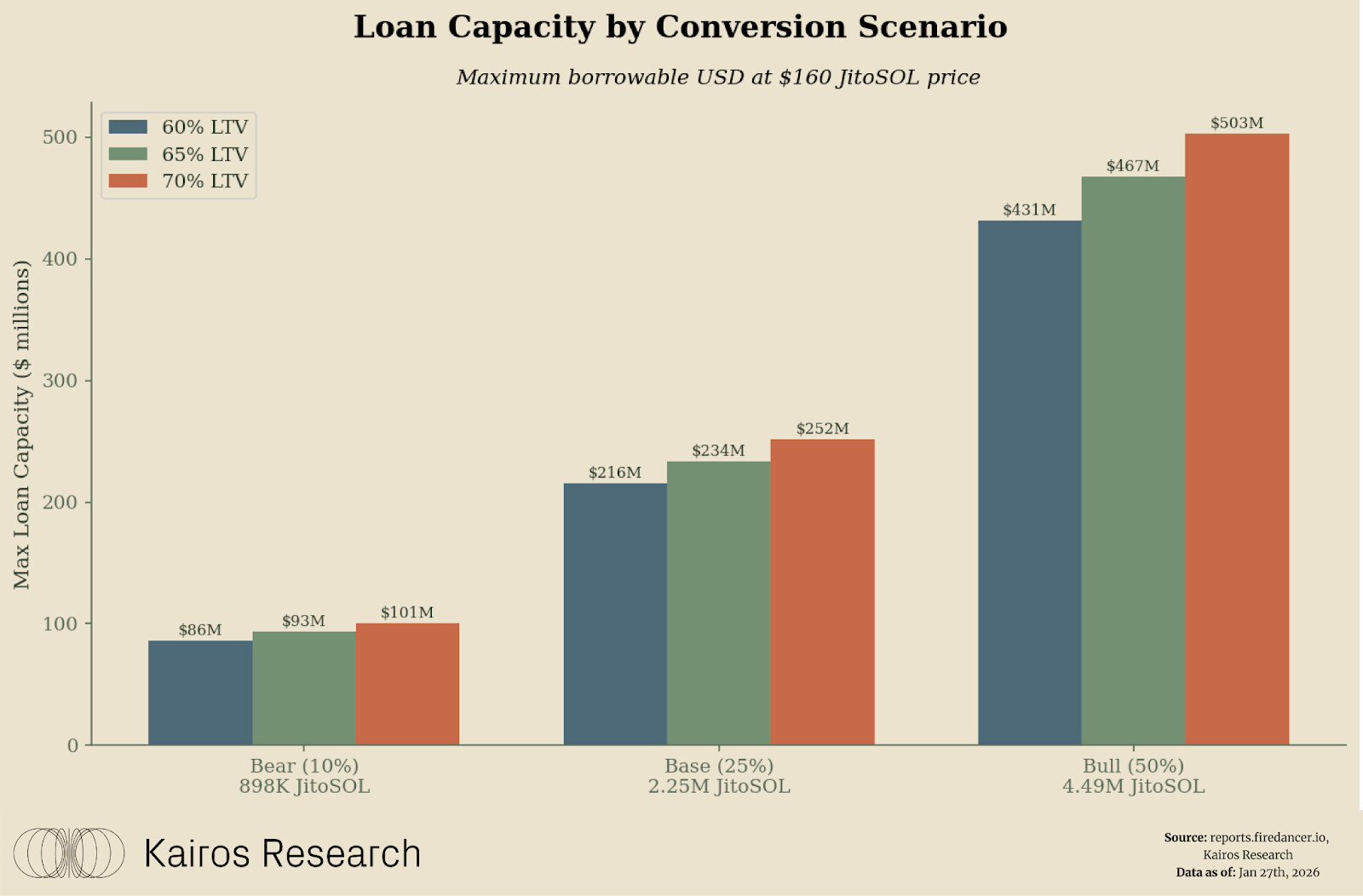
Coinbase brings 8.99M SOL in current addressable stake and retail distribution that has not yet been accessible for JitoSOL. The lending product unlocks $230M+ in borrowing capacity using our base case assumption, and also enables looping leverage that could amplify TVL growth by 1.5x - 1.7x, further enhancing the stake weight of BAM Jito can achieve via Coinbase.

Economics

The ordinary 4% management fee flows to Coinbase, not the DAO. In our base case, DAO revenue drops from $4.41M to $4.20M assuming 16% TVL growth. In this case Coinbase captures $650K. This is the cost of the partnership, and we think it’s worth paying.

Scenario TVL DAO Revenue Coinbase Capture
Current 14.43M $4.41M N/A
Bear (+6%) 15.33M $4.33M $273K
Base (+16%) 16.67M $4.20M $650K
Bull (+31%) 18.92M $4.04M $1.26M

Addressable Market

Coinbase runs 8.99M SOL across four validators, representing 62% of current JitoSOL TVL. Stake accounts could be transferred for existing users, as well as receive net new stake.

Growth

The conversion rates in our model (10%, 25%, 50%) refer to what percentage of Coinbase’s 8.99M SOL converts to JitoSOL. The TVL growth percentages (6%, 16%, 31%) are the resulting impact on JitoSOL’s 14.43M TVL.

So the mapping is as follows:

Bear: 10% conversion × 8.99M = 0.9M new SOL → +6.2% TVL growth

Base: 25% conversion × 8.99M = 2.25M new SOL → +15.6% TVL growth

Bull: 50% conversion × 8.99M = 4.49M new SOL → +31.1% TVL growth

Looping Leverage: The Multiplier Effect

The interesting aspect about the partnership in our opinion is that the lending product doesn’t just create borrowing capacity it enables recursive leverage that amplifies key metrics.

The mechanics: A user deposits JitoSOL → borrows USD at 65% (this is a hypothetical LTV) LTV → buys SOL → mints more JitoSOL → repeats. At 65% LTV with 4 loops, 1M JitoSOL becomes 2.53M of exposure. The theoretical max is 2.86x (1/(1-0.65)), but practically we model 2-2.5x for active loopers.

Why this matters for BAM:

  1. TVL Expansion: If 50% of new Coinbase users loop, the 2.25M base case becomes 3.4M effective TVL (+51% vs no looping)

  2. Coinbase Pool Share: Looping amplifies Coinbase’s share of the JitoSOL pool from 13.5% to 19%+ depending on participation

  3. BAM Stake Weight: More JitoSOL = more stake routed through Jito’s validator set. At 50% looping, CB’s share of network stake grows from 4.2% to 4.5%

This is the unintentional potential flywheel Jito could have: lending utility → looping demand → TVL growth → larger stake weight → more MEV capture → better yields → more adoption.

Looping Participation Effective New TVL Coinbase Pool Share Coinbase Network
No Looping 2.25M 13.50% 4.20%
30% Loop 2.9M 16.90% 4.30%
50% Loop 3.4M 19.00% 4.50%
70% Loop 3.8M 21.00% 4.60%

Lending Capacity

At 65% LTV and base conversion: $234M capacity without looping. With moderate looping participation, effective capacity scales to $350M+. This creates sticky, utility-driven demand that compounds Coinbase’s contribution to the pool. For context, Coinbase offers ~86% LTV for cbBTC/USDC loans

Overall JIP-33 is further proof that Jito’s primary focus is BAM adoption. The economics subsidize Coinbase, but the lending product potentially creates a leverage flywheel that amplifies TVL, Coinbase’s pool share, and BAM’s network stake weight. Ultimately this prop is betting that distribution and utility compound faster than short-term yield dilution. We think this is the right long term bet.

3 Likes

The analysis above is really helpful. I agree with much of the sentiment and I think I’d vote for this. But I still thinkit leaves out some relevant considerations on the competitive dynamics at play here and is not clear enough on how the DAO is measuring ROI on this spend…

None of the Coinbase validators you mentioned above have integrated BAM today. It appears that they are actually using Harmonic for all of their public validators. Will Coinbase integrate BAM across any other SOL that is staked or only jitoSOL balances held by customers?

Is it correct that this fee waiver would continue indefinitely? A expiry date would help to constrain the opportunity cost (analysis above mentions 200k foregone revenue / 650k total value to Cb but I those are annual numbers) and would be better precedent for next collaboration. Why not split the mgmt fee 50/50?

How should we think about quantifying the value to Jito Network of an incremental 3.8M of SOL staked to BAM-participating validators? “more JitoSOL = more stake routed through Jito’s validator set”… how much is this incremental 0.3% of network stake expected to be worth to the DAO?

I think this proposal potentially undersells the value that Jito Network is bringing to the collaboration in the short term by providing an excellent product in jitoSOL with deep liquidity and a trusted brand. Further, the DAO is already subsidizing BAM adoption through the use of protocol revenues and a standing budget of JTO from the treasury.

2 Likes

We acknowledge most of the positive points shared above and thanks to those who replied, as they definitely provide very interesting data.

However, I think this deal touches other aspects that might influence the long term and we should not only address it from the inmediate DAO revenue perspective, but also from the network neutrality, branding impact and existing JitoSOL holders perspective.

I would like to start by emphasizing that Jito BAM is not JitoSOL. One of the points that immediately came to my mind is why we need to incentivize BAM adoption by sacrificing JitoSOL APY. BAM has indeed several benefits for the network and I’m not sure why Coinbase needs to be incentivized to adopt it.

In parallel, as mentioned in the proposal by Nick, I would like to re-emphasize the Coinbase stake concentration risk. If existing JitoSOL holders are sufficiently disincentivized compared to other staking options with higher yield, that could generate a bigger concentration of Coinbase stake and reduce one of the biggest incentives for validators to run BAM. This could trigger a stake replacement not only in JitoSOL, but also a disincentive for BAM adoption.

Finally, points above might trigger a brand impact. Jito is institutionalizing and that’s not negative. However, having such a large share of Coinbase stake within JitoSOL can be perceived as JitoSOL becoming an extension of Coinbase in the network. That’s not necessarily negative, but it would encourage the centralization narrative that Jito has already faced as a centralized sequencer.

1 Like